Showing posts with label Brazilian stuff. Show all posts

4.05.2017

An admirable Brazilian song

Every single music lover knows: Samba is the most authentic genre of Brazilian music. Originated from African rhythms, samba is the cultural portrait of my country to many people. Though I personally prefer hard rock and heavy metal, that contagious Brazil's beat also appeals to me.

Last month (in my other blog) I spoke briefly of a Brazilian song - Pra que discutir com madame? - that I really enjoy (Besta Quadrada, the other blog, is written in Portuguese; if you want to visit it, click here). Pra que discutir com madame? was composed by Haroldo Barbosa and Janet de Almeida in 1956. Years later, singer and acoustic guitarist João Gilberto recorded it, making it known abroad.

How about listening to the song?


A few days ago, I came across with a nice translation of the song lyric in the musician João Macdowell's blog.

Check it out (I put the translation lines and the original Portuguese lyrics side by side):


WHY SHOULD I ARGUE WITH MADAM? (PRA QUE DISCUTIR COM MADAME?)                                           

Madam says the reason the race does not improve, (Madame diz que a raça não melhora,)
That life just gets worse because of Samba (Que a vida piora por causa do samba)
Madam says that Samba is full of sin (Madame diz que o samba é pecado)
That poor Samba should disappear. (Que o samba, coitado, devia acabar)

Madam says that samba has cachaça, (Madame diz que o samba tem cachaça,)
mixing races, mixing colors, (mistura de raça, mistura de cor,)
Madam says that democratic Samba (Madame diz que o samba democrata)
is just cheap music, it’s worthless. (É música barata sem nenhum valor)

                                        
                                         [Chorus:]
Let’s put an end to the Samba, (Vamos acabar com o samba,)
Madam doesn’t like to see the Samba (Madame não gosta que ninguém sambe)
She keeps on saying Samba is a shame (Vive dizendo que samba é vexame)
Why should I argue with Madam? (Pra que discutir com madame?)

Carnival is near, and this year I’m in the contest  (No Carnaval que vem também concorro)
My gang from the favela is coming down, singing opera. (Meu bloco de morro vai cantar ópera)
and in the sweaty alleys, when it’s hot, loud and packed, (E na avenida entre mil apertos)
every single voice will sing a concert. (Vocês vão ver gente cantando concerto)

Madam is a little bit nuts (Madame tem um parafuso a menos)
She spits out so much poison, My God, what a shame (Só fala veneno, Meu Deus, que horror)
Brazilian democratic Samba (O samba brasileiro democrata)
Roots of Brazil, we have pride and we know our worth. (Brasileiro na batata é que tem valor)


Come to think of it, I would've translated the last line a little bit differently... Anyway. Macdowell claims that "the lyrics present a very straight forward version of the narrative of cultural conflicts and coexistence of contrasting systems of value that permeates Brazilian culture. There is a rich discourse about the nature of this cultural tension that is exposed through the song". I totally agree with him.

Furthermore, the tune is simply irresistible, mainly when the song is played by a complete group of sambistas, like these guys below, joined to the marvelous singer Teresa Cristina. Enjoy yourself!

3.08.2017

#CoupDetatInBrazil


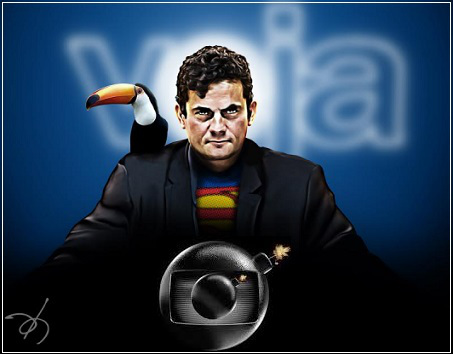
There's something really, really out of order when the country's hero (in the opinion of part of the population, not mine, let me set straight it) is a biased judge.

2.25.2017

Carnaval? Hell no!!!


What is the first thing you remember when it comes to Brazil? Let me guess: the national soccer team? The statue of Christ the Redeemer? Its endless political scandals and violent cities?

Many people may say CARNAVAL (or Brazilian Carnival, if you insist...). You've already heard about it, for sure. A enormous street festival, samba-schools parades, five or more days of fun, craziness and senselessness all around the country... Sounds good, no? Wrong!!! (But I must admit, I can't complain about the days off, hehehe...).

It's not a matter of age; even when I was younger, I couldn't stand Carnaval too - except the costume thing (some outfits are pretty cool). Everybody acts as if they had to be cheerful and full of effervescent enthusiasm all the time. It's so hollow, if you think about it. We have to deal with traffic jams in the main roads and highways, crowded beaches, tiresome media broadcasts, with the same lame event being shown over and over. Besides, brazilian women often suffer sexual harassment during Carnaval. It's horrible.

If someone, singing and dancing in a bloco, invites me: "Join us!", I reply: "Thank you but I'm out".

Carnaval? Hell no!!!

2.15.2017

Hands talk a lot in Brazilian Portuguese

Terminator (model T-800, played by Arnold Schwarzenegger) is about to leave a gas station convenience store (taking goods out) when the clerk, worried and a little bit angry, tell him: "Hey, are you gonna pay for that?". And the robotic tough guy replies: "Talk to the hand!".

I don't know about you, but the first time I've heard that expression (check out its meaning here) was in Terminator 3: Rise of the Machines. Nobody talks to hands, of course, but we can talk with our hands (and I'm not referring to sign language).

Some gestures are rapidly understood in many countries because they have the same meaning, regardless the nationality or slight cultural differences (well, at least in the West). A few nods are immediately comprehensible as soon as someone make them. Thumb up is a positive thing in any place, I guess, and all of us know that a index finger in front of someone's puckered mouth is asking for silence.

However, some gestures of certain countries are so peculiar that it's necessary explain them. Take a look at this enjoyable Babbel's video about 7 common brazilian gesticulations (I make them - except the last one - all the time, it's true!).


2.04.2017

Being black in Brazil


First of all, shall we read some lines of Adão Ventura?

"Come shine or come storm,
my body is enclosed
by this black skin".

Ventura was a brazilian poet. He lived many years here in Belo Horizonte (my hometown) and passed away in 2004. It's funny that his poetry - brave, simple, straightforward - remains unknown for the most in my country. Unfortunately. 

Let's read the rest of the poem:

"Come shine or come storm,
my body is fenced
by these high walls
- corrals
where is still coagulated
the blood of slaves

Come shine
or come storm,
my body is enclosed
by this black skin".

Several Adão Ventura's poems often remind me that Brazil is not a racial democracy, as many people think (inside and outside the country). Brazilian racial democracy is a myth! Just take a look at our parliament. Although more than 50% of Brazil's population are black there are less than 5% african-brazilians in the Congress. The same "standard" is repeated on entertaiment industry, fashion, advertising. And what about the wage gap between whites and blacks? What about police brutality against black people?

I'm proud to be a black brazilian guy. But I must recognize too: We have serious issues with racism here, even though some people pretend not see them.