Just for fun, I've asked to ChatGPT: "How to make life easier?". Here's its response:
"Making life easier can involve various approaches and solutions, depending on the individual's specific challenges and needs. Here are some general tips that could help:
1) Get organized: Having a clear and organized system for managing your daily tasks and responsibilities can help simplify your life. This could involve using a planner, creating to-do lists, and streamlining your possessions.
2) Automate routine tasks: Consider using technology and tools to automate repetitive tasks, such as paying bills or scheduling appointments.
3) Practice self-care: Taking care of your physical and emotional well-being can help reduce stress and make life feel more manageable. This could include getting enough sleep, exercise, and eating a healthy diet.
4) Simplify your possessions: Decluttering and simplifying your possessions can reduce stress and make it easier to manage your environment.
5) Seek help: Don't be afraid to ask for help when you need it. Whether it's delegating tasks, seeking support from friends and family, or seeking professional assistance, having help can make life easier.
6) Set achievable goals: Identifying specific, achievable goals and breaking them down into smaller steps can make life feel more manageable and help you focus on what's important.
7) Find joy and purpose: Focusing on activities that bring you joy and a sense of purpose can make life feel more fulfilling and enjoyable.
Remember, making life easier is a process that takes time and effort, but the reward is a more balanced, fulfilling life".
In my case, all those tips are useless (especially the seventh one). I'm really fucked up, mentally and physically speaking.
It was quite unexpected when I saw Denise Dumont singing Tico-Tico no Fubá, 30 years ago, in the very beginning of Radio Days. In case you don't know, she is a Brazilian actress who has been living in New York since the end of the eighties (her husband is british writer/director/producer Matthew Chapman).
In Radio Days - a Woody Allen's film, released in 1987 -, Denise plays a latin singer who performs in a bar or something like that. The scene is very short, but it's easy for many Brazilians to recognize both melody and lyrics of Tico-Tico no Fubá. In spite of its first recording had been made in 1931, the song became popular in the 1940s, thanks to Carmen Miranda.
Speaking of her, Miranda was kinda the first "Brazilian music ambassadress" in the US. If on the one hand her work contributed to diffuse part of our culture abroad, on the other hand her outfit (especially her striking fruit hat) turned into a stereotype of the Brazilian women. Anyhow, Carmen Miranda helped to promote important Brazil's songwriters, like Dorival Caymmi.
It's so cool when I'm watching an American movie and I hear a familiar tune, with a voice singing in Portuguese! Some years ago, I saw Nacho LIbre, starred by Jack Black. It's a silly, funny movie, no big deal, but at one point, I said to myself: "Wait... I know that voice! I know that song!". The track was Irene, by Caetano Veloso. Recently, I had the same feeling when I was watching You're not you, starred by Hilary Swank. The Brazilian song included in its soundtrack is the marvellous Malemolência, by Céu.
Translating the word malemolência to English is tough. However, googling around, I've found this amazing and very satisfactory solution: Swing Mood. How about to replicate the original words in Portuguese here, followed by the entire translation of the song lyrics, made by José Thomaz?
Malemolência (Swing Mood)
Veio até mim (You came up to me) Quem deixou (Who did allow ) Me olhar assim (You look at me this way) Não pediu (You didn't) Minha permissão (Ask for my permission) Não pude evitar (I couldn't avoid it) Tirou meu ar (You stole my breath) Fiquei sem chão... (I felt so lost)
É tudo o que eu posso (That's all that) Lhe adiantar (I can tell you now) O que é um beijo (What is a kiss) Se eu posso ter o teu olhar? (If I can have your eyes) Cai na dança, cai! (Let us dance, dance!) Vem pra roda (Come to the dance) Da malemolência... (In a swing mood)
É tudo que eu posso (That's all that) Lhe adiantar (I can tell you now) O que é um beijo (What is a kiss) Se eu posso ter o teu olhar? (If I can have your eyes) Cai na dança, cai (Let us dance, dance) Vem pra roda (Come to the dance) Da malemolência... (In a swing mood)
Let's finish with a video, shall we? During her performance of Malemolência, below, Céu and her band incidentally include another song, Mora na filosofia (written by Monsueto Menezes e Arnaldo Passos)
Probably you've already watched Ferris Bueller's Day Off, haven't you? (It's one of my favorite 1980's comedies). But do you know what is the title of the movie here in Brazil? Curtindo a vida adoidado - something like Enjoying life insanely. What the hell? And how about the unforgettable 1970's series Charlie's Angels? As Panteras, i.e. The (Female) Panthers...
The "creativity" has no limits, as you can see. I think the mainly reason behind that weird, inaccurate renaming in Portuguese is an alleged commercial appeal. Local entertainment distributors have made up those titles because they take for granted that the ones fabricated by them would be able to attract bigger audiences than a bare translation would do. Recently, I've got puzzled by two of those... er... "inventive" names.
Truth - a James Vanderbilt's film, starring Cate Blanchett and Robert Redford, released in 2015 - has become Conspiração e Poder (or Conspiracy and Power) here in Brazil. Wouldn't it be easier and simpler just using the word Verdade (truth, in Portuguese)? Maybe I'm wrong but the acts of a team of journalists (and their consequences), as well as the media responsability, are the central theme of this movie. Verdade would be a proper title in Portuguese, since the storyline discusses, in a sense, the concept of truth in journalism.
The most bizarre renaming, however, is found in the series Black-ish.
The awesome ABC show has come to be Família Desajustada (i.e. Troubled Family or Dysfunctional Family). You gotta be kidding me...
When I was younger I used to play basketball, even living here in Brazil.
So what?
Well, it is surprising because, as you probably know, soccer is kind of a mandatory religion, when it comes to this tropical, peculiar country. So, every Brazilian - since their childhood - is condemned to "the curse of one-single-sports mindset".
What does it mean?
Let me give you some examples.
PE classes are nothing but impromptu soccer matches for schoolboys in the majority of educational institutions. Female students, on the other hand, play some sort of dodgeball (we call it "queimada"). In public places, small talks usually involve chatting about the last soccer games. Brazilian sports journalism is focused on soccer - 95% of the time. Need I say more?
Against all odds, however, I became a huge basketball enthusiast. And, of course, like the worldwide opinion, NBA is the most-beloved competition.
Naturally, I have my favorite players. John Wall, DeMar DeRozan, Kevin Durant, Draymond Green and Karl-Anthony Towns - this would be my ideal lineup. Each one, in my opinion, have brought some valuable, wonderfull and - at the same time - uncomplicated things to the game. DeRozan, by the way, is the best illustration of that.
Toronto Raptors' shooting guard has been presenting a nice, classic playing style on court; his moves remind me the 1980' ones (I started to see NBA broadcasts at that time), however, with the athleticism of the present-day guys. DeRozan's stats have proven his worth to the team and a large number of fans agree that he deserves to be called a star (speaking of which, he was elected to NBA All-Star Game four times - 2014, 2016, 2017 and this year).
But DeRozan's elegant "old-fashioned" way is changing a little. And it's necessary, if he wants to be even more important for his team (and even more prominent in the league). Being a good three-point shooter is crucial nowadays. He's realized it and his numbers around the perimeter show that.
In his first NBA season DeRozan tried, on average, 0.2 three-point field goals per game; in his fourth one, an increase to 1.5. Recently, he attempted 3.6 three-pointers per game in 2017-18 season. His efficiency behind the 3-point line is not that good yet, but the Raptors' player has learnt that his playing style must incorporate those shots, since many guards, forwards and even centers have been developing that ability.
It's not a secret. Every NBA team - even San Antonio Spurs - needs three-pointers, if they want to go ahead and, eventually, win the championship. I think it's not an exaggeration to say that NBA players have been facing a "dilemma": Be a three-point shooter or die.
The amount of programs on Brazilian TV in which soccer is the one single subject discussed is unbelievable!
Besides the live broadcasts of a considerable amount of matches (played here or abroad), there is a profusion of shows where former athletes, journalists, commentators and some sort of "sporting pundits" talk (a lot) and (often) argue about the game, as if it was the most important stuff in the whole world.
It's not easy to find good information about other sports on local traditional media. People who loathe soccer, like me (but love basketball, volleyball, tennis, judo, skateboarding...), usually have a hard time watching Brazilian channels - even on pay-TV.
And why are there so many interviews with soccer players? I frankly can not see what is their point. What are those conversations for? Don't get me wrong, pal. I'm not saying that all soccer players are complete morons (even though some of them, definitely, are); I'm complaining because those interviews are repetitive, full of commonplaces and obviousness. Most of the players sound the same when they are talking!
Youtuber Lilly Singh made a hilarious video that may be kind of helpful now, I think. She is mocking interviews with athletes in general, in the North American context, but it's pretty similar to Brazil and its soccer players. Check it out:
As she said, at the moment of the interview, "every player literally turns into Captain Obvious and says nothing of value". But I agree with her: Athletes have other fantastic skills and "not everyone can be a great speaker and take great shots".
Before I forget: TV reporters also could improve their questions, couldn't they?
This morning, on my Twitter account, I wrote about a topic that upsets me a little: Is there such a thing as "fundamentalist atheists"? With some small changes, here's what I posted on Twitter * :
I usually get kinda confused when I hear or read the expression "fundamentalist atheist".
OK, fine, I must admit that atheist people (like me) can be obnoxious, condescending, wannabe intellectuals and a little bit authoritarian sometimes. BUT, definitely, we're not fundamentalists.
In my opinion, fundamentalist atheist sounds like a contradiction in terms because, strictly speaking, we, atheists, don't follow a so-called holy book that would be the fundament of our beliefs and thoughts.
So, if you want to criticize, irritate or simply offend atheists (no problem; it's part of the democratic coexistence), I suggest calling us "sectarian", or "intolerant", or "narrow-minded". (How about "pompous fucking bastards"?)
"Fundamentalist", however, is quite inaccurate in this case, I think.
Everybody loves Madonna, don't they? Also called the "Queen of Pop", she became a show business icon during the two last decades of the 20th century. Even though she's not on the top of the best-selling singers' list currently, it's hard to not keep in mind her former renown, as well as her hits.
Speaking of her most popular songs, a few days ago I turned on the radio and La Isla Bonita was playing. I started to sing along when suddenly I realized that there was a substantial mistake in the lyrics. (Once that track was released in 1987, I took thirty years to notice the error. What a moron!).
She sings:
"And when the samba played
The sun would set so high Ring through my ears and sting my eyes Your Spanish lullaby"
Wait a second... What? The whole tune has nothing to do with samba! We can hear Cuban drums and something like Caribbean tones, a Spanish acoustic guitar... However, the famous Brazilian beat is not on the menu. So why the hell did Madonna come up with the word samba?
My guess: Many Americans (even nowadays) think that cha-cha, mambo, rumba, samba and other Latin rhythms are the same stuff; Latin America, in their opinion, has indistinguishable cultural traits from country to country - thus, who would care about the difference between salsa and merengue, or between cumbia and conga?
Well, I care.
As a Latin American (as a Brazilian, to be more specific), I'm able to say: La Isla Bonita, despite its enchantment, is not samba at all!
My mantra from now on: Don't read the comments on social media. Don't read the comments on social media. Don't read the comments on social media. Don't read the comments... Off course, I'll never make comments again as well.
Every single music lover knows: Samba is the most authentic genre of Brazilian music. Originated from African rhythms, samba is the cultural portrait of my country to many people. Though I personally prefer hard rock and heavy metal, that contagious Brazil's beat also appeals to me.
Last month (in my other blog) I spoke briefly of a Brazilian song - Pra que discutir com madame? - that I really enjoy (Besta Quadrada, the other blog, is written in Portuguese; if you want to visit it, click here). Pra que discutir com madame? was composed by Haroldo Barbosa and Janet de Almeida in 1956. Years later, singer and acoustic guitarist João Gilberto recorded it, making it known abroad.
How about listening to the song?
A few days ago, I came across with a nice translation of the song lyric in the musician João Macdowell's blog.
Check it out (I put the translation lines and the original Portuguese lyrics side by side):
WHY SHOULD I ARGUE WITH MADAM? (PRA QUE DISCUTIR COM MADAME?)
Madam says the reason the race does not improve, (Madame diz que a raça não melhora,)
That life just gets worse because of Samba (Que a vida piora por causa do samba)
Madam says that Samba is full of sin (Madame diz que o samba é pecado)
That poor Samba should disappear. (Que o samba, coitado, devia acabar)
Madam says that samba has cachaça, (Madame diz que o samba tem cachaça,)
mixing races, mixing colors, (mistura de raça, mistura de cor,)
Madam says that democratic Samba (Madame diz que o samba democrata)
is just cheap music, it’s worthless. (É música barata sem nenhum valor)
[Chorus:]
Let’s put an end to the Samba, (Vamos acabar com o samba,)
Madam doesn’t like to see the Samba (Madame não gosta que ninguém sambe)
She keeps on saying Samba is a shame (Vive dizendo que samba é vexame)
Why should I argue with Madam? (Pra que discutir com madame?)
Carnival is near, and this year I’m in the contest (No Carnaval que vem também concorro)
My gang from the favela is coming down, singing opera. (Meu bloco de morro vai cantar ópera)
and in the sweaty alleys, when it’s hot, loud and packed, (E na avenida entre mil apertos)
every single voice will sing a concert. (Vocês vão ver gente cantando concerto)
Madam is a little bit nuts (Madame tem um parafuso a menos)
She spits out so much poison, My God, what a shame (Só fala veneno, Meu Deus, que horror)
Brazilian democratic Samba (O samba brasileiro democrata)
Roots of Brazil, we have pride and we know our worth. (Brasileiro na batata é que tem valor)
Come to think of it, I would've translated the last line a little bit differently... Anyway. Macdowell claims that "the lyrics present a very straight forward version of the narrative of
cultural conflicts and coexistence of contrasting systems of value that
permeates Brazilian culture. There is a rich discourse about the nature
of this cultural tension that is exposed through the song". I totally agree with him.
Furthermore, the tune is simply irresistible, mainly when the song is played by a complete group of sambistas, like these guys below, joined to the marvelous singer Teresa Cristina. Enjoy yourself!
"Book Age is over!". "It's the end of Gutenberg's Galaxy'". "Nobody reads paper books nowadays". "In the future, there will be only reading on digital devices".
How many times have you heard/read claims like these?
I've been thinking a lot about reading, mainly printed books reading (after all, it's a pivotal part of my current job). Some weeks ago, I was searching for a few images of people with books in their hands and I found beautiful pictures in a BBC report (signed by Fionna Macdonald), Striking photos of readers around the world.
The article highlights On Reading, a photographer Steve McCurry's book, which gathers pictures that were taken over past 40 years; some of them, according to Macdonald, are "glimpses of people absorbed in the written word, many unaware they were being photographed".
Take a look at this:
The photo was taken at a museum (Umbria, Italy). I think the enormous skeleton legs belong to the sculpture named Calamita Cosmica, created by Gino De Dominicis. But the woman doesn't seem interested in it. Maybe she's an employee of the museum. Maybe she's seen that sculpture hundreds and hundreds of times and - meh - it isn't so fascinating anymore. Who knows? What is she reading? A catalogue? The picture whets our curiosity (it's irresistible, isn't it?).
And what about this one?
It was taken in 2013. The kid is a member of the Suri Tribe (Tulget, Omo Valley, Ethiopia). It looks like he's at school. Why is he alone? Is he doing a difficult task or just reading for fun?
The next one is odd and thrilling:
What is this facility? Looks like a power plant. The photo (taken in 1991, in Kuwait, i.e. after or even during the Gulf War) shows a man, surrounded by rubble, focused on a simple book!
We couldn't forget my country, could we?
This stunning library is the Real Gabinete Português de Leitura (Royal Portuguese Cabinet for Reading), founded in 1837 (Rio de Janeiro, Brazil) and still working today.
"The question of what books do and what they are for is, of course, an abiding one. For Kafka, books were “the axe for the frozen sea within us”; for Carl Sagan, “proof that humans are capable of working magic”; for James Baldwin, a way to change our destiny; for Neil Gaiman, the vehicle for the deepest human truths; for Polish Nobel laureate Wisława Szymborska, our ultimate frontier of freedom. Falling closest to Galileo, who saw reading as a way of having superhuman powers, Hesse considers the historical role of the written word:
'With all peoples the word and writing are holy and magical; naming and writing were originally magical operations, magical conquests of nature through the spirit, and everywhere the gift of writing was thought to be of divine origin. With most peoples, writing and reading were secret and holy arts reserved for the priesthood alone.
[…]
Today all this is apparently completely changed. Today, so it seems, the world of writing and of the intellect is open to everyone… Today, so it seems, being able to read and write is little more than being able to breathe… Writing and the book have apparently been divested of every special dignity, every enchantment, every magic… From a liberal, democratic point of view, this is progress and is accepted as a matter of course; from other points of view, however, it is a devaluation and vulgarization of the spirit'.
All those authors and I are on the same page.
One more thing: Paper books are not a thing of the past. They are still required. Long live the paper books!
March 11 1962: Maria Paula Gonçalves da Silva was born in Osvaldo Cruz, Brazil. Nicknamed Magic Paula (relating to former american point/shooting guard Earvin "Magic" Johnson), she is one of the greatest basketball players of all times - and one of my idols! (In 2002, I got her handwritten signature on this book shown above; it was wonderful!).
One of these days, I'll write about her and why she's so outstanding to me.
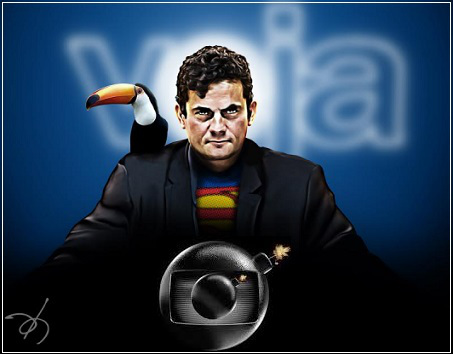
There's something really, really out of order when the country's hero (in the opinion of part of the population, not mine, let me set straight it) is a biased judge.
In Brazil, free-to-air television channels are despicable. So, if you don't want to kill yourself while you're watching TV, you'll have to pay.
However, brazilian pay-TV leaves a lot to be desired. It's inflexible and kinda expensive (mainly if you consider the average wage of brazilian workers). Even being a badly paid civil servant, I'm a subscriber. Then you may ask me: And what about the shows, programs, movies? Are they satisfactory at least?
Well... Let's only talk about movies, right? (Doing so, I guess I'm gonna be able to stay calm...).
Last week, for instance, Paranormal activity: The marked ones and Kick-Ass were scheduled in three channels! Both flicks are fine, but they - like lots of others - have been repeated excessively! Of course, it's just a nasty way to force us to purchase another TV package (with HBO included, for instance, that will cost us more), or to buy on-demand contents (like NOW). That's why pay-TV companies hate Netflix!
In other hand - and speaking of overly repeated movies -, why, why, WHY those channels adore Adam Sandler so much???
Whenever you turn on the TV you see a Sandler's stuff on the air. And some of his films - pardon my French - are a gigantic amount of crap. Do you disagree? Fine. But, please, answer me: Who can put up with things like Jack and Jill, Happy Gilmore, Billy Madison, Little Nick or (for Zeus' sake!) You don't mess with the Zohan?
Hey, pay-TV companies, since you're not gonna stop repeating movies, could you choose comedies truly funny at least?
What is the first thing you remember when it comes to Brazil? Let me guess: the national soccer team? The statue of Christ the Redeemer? Its endless political scandals and violent cities?
Many people may say CARNAVAL (or Brazilian Carnival, if you insist...). You've already heard about it, for sure. A enormous street festival, samba-schools parades, five or more days of fun, craziness and senselessness all around the country... Sounds good, no? Wrong!!! (But I must admit, I can't complain about the days off, hehehe...).
It's not a matter of age; even when I was younger, I couldn't stand Carnaval too - except the costume thing (some outfits are pretty cool). Everybody acts as if they had to be cheerful and full of effervescent enthusiasm all the time. It's so hollow, if you think about it. We have to deal with traffic jams in the main roads and highways, crowded beaches, tiresome media broadcasts, with the same lame event being shown over and over. Besides, brazilian women often suffer sexual harassment during Carnaval. It's horrible.
If someone, singing and dancing in a bloco, invites me: "Join us!", I reply: "Thank you but I'm out".
Last year, brazilian writer Raduan Nassar was honored with Camões Prize, the biggest premium to authors from Portuguese speaking countries community. Many people consider him the most important brazilian novelist alive. But all these credentials haven't prevented current brazilian federal government to disrespect him.
The prize was received by Nassar last Friday (2. 17. 2017), during a ceremony at Lasar Segall Museum, in São Paulo. In his speech, the writer spoke out on Brazil's present situation ("We've lived in dark times".), as well as denounced the wrongdoings of Michel Temer's administration ("The mentioned facts configure, by extension, a repressive government as a whole: against workers, against judicious retirements, against federal universities of gratuitous education [..]. Government linked, by the way, to neoliberalism, with its scandalous concentration of wealth, which has been worsening the poor people's life of the whole world"). The full speech can be found here (in Portuguese)
Shortly after, the government official, Culture Minister Roberto Freire, discourteous, rather than just pretending that he had nothing to do with those issues, talked shit, having a row with the ceremony guests.
Why are politicians so arrogant, generally so full of their own "importance"?
Raduan Nassar, 81 years-old, is a recluse man who retired from literary life in 1984 and nobody knows why. Since then, he's become a full-time farmer whose public appearances are quite rare. So, when this man is receiving a remarkable literary distinction I think he's entitled to say whatever he wants to! His work is much more important to my country than the current government, which has arisen from a stealthy coup d'etat, backed by media companies and some members of the judiciary.
Terminator (model T-800, played by Arnold Schwarzenegger) is about to leave a gas station convenience store (taking goods out) when the clerk, worried and a little bit angry, tell him: "Hey, are you gonna pay for that?". And the robotic tough guy replies: "Talk to the hand!".
I don't know about you, but the first time I've heard that expression (check out its meaning here) was in Terminator 3: Rise of the Machines. Nobody talks to hands, of course, but we can talk with our hands (and I'm not referring to sign language).
Some gestures are rapidly understood in many countries because they have the same meaning, regardless the nationality or slight cultural differences (well, at least in the West). A few nods are immediately comprehensible as soon as someone make them. Thumb up is a positive thing in any place, I guess, and all of us know that a index finger in front of someone's puckered mouth is asking for silence.
However, some gestures of certain countries are so peculiar that it's necessary explain them. Take a look at this enjoyableBabbel's video about 7 common brazilian gesticulations (I make them - except the last one - all the time, it's true!).
How many books do you read a year? (Hey, relax. It's just a rhetorical question, okay?).
To tell you the truth, books are not in vogue these days - come to think of it, they've never been popular before. Ordinary people couldn't afford to buy them. (Just consider the situation in the 1800s or even in the first half of the 20th century, not to mention that a book could cost more than 40 sheep in the Middle Age!).
As if it weren't already bad enough, many people are one-single-book readers. They think it's a big, huge deal - "wow, we've been reading the Book!" - but, in my opinion, it closes their minds and becomes them more bigoted, more intolerant.
As the actor Billy Connoly once said, "Never trust people who've only got one fucking book".